ALABAMA AIR NATIONAL GUARD PILOTS K.I.A. AT THE BAY OF PIGS
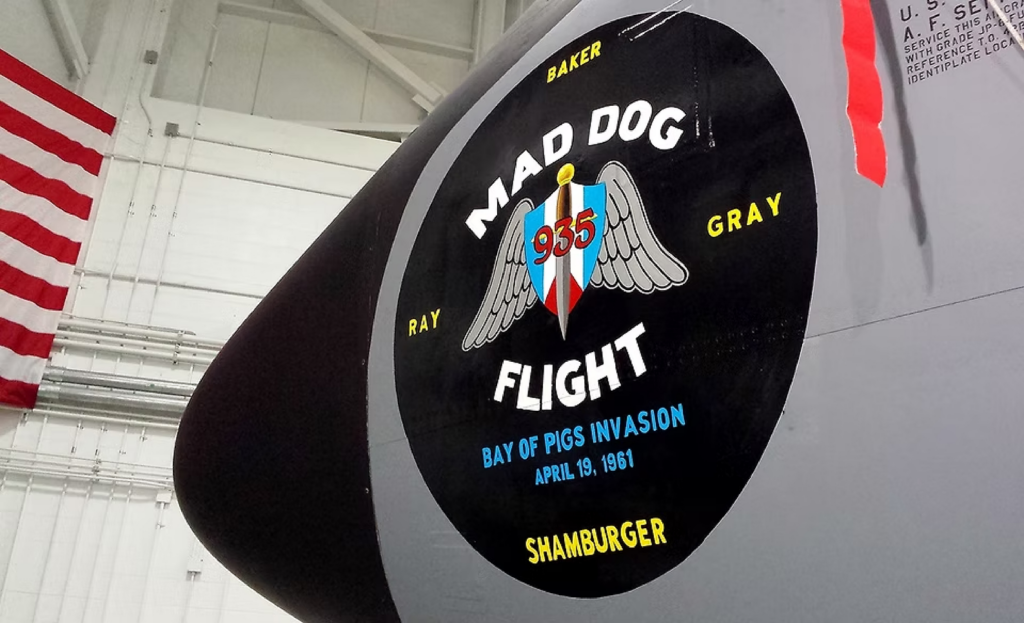
In the morning of April 19 (D+2) five aircraft (B-26s) of the Brigade Air Force, four of them with American crews, were sent in sorties over the Giron beachhead. Three, including two piloted by Americans, were shot down.
The four American crew members were able to bailout but were captured by Castro’s militia and promptly executed. They were Cap. Thomas W. Ray, Cap. Leo Baker, Cap. Wade C. Gray, and Cap. Riley W. Shamberger.
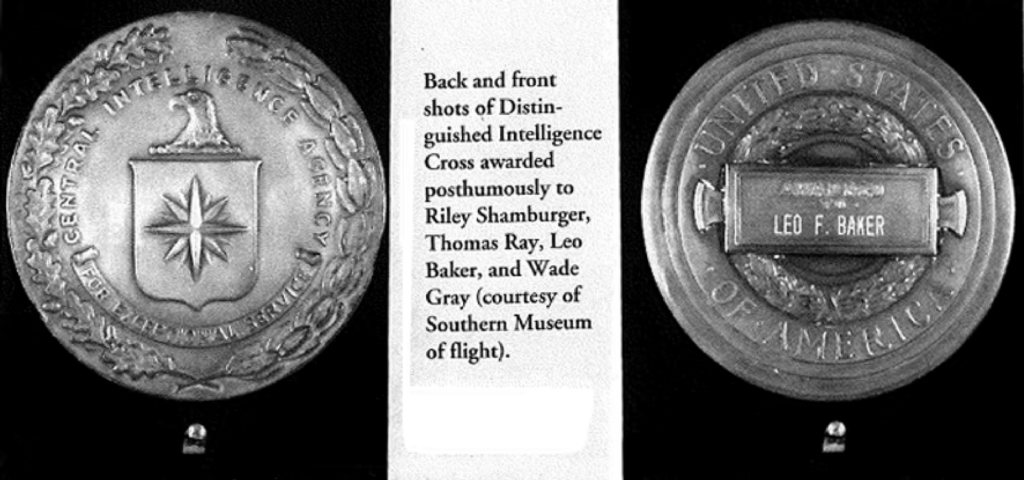
In the late 1990s, Captain Thomas Willard Ray and his navigator, Leo Baker, were posthumously awarded the Intelligence Star for their actions in the Bay of Pigs Invasion leading to their capture and execution.
Thomas Willard Ray was killed in action while piloting a Douglas B-26 in the Bay of Pigs Invasion. The US-trained Air Force (FAL) Brigade 2506 in Guatemala Retalhuleu, named Base RAYO. Captain Willard Ray, a pilot of the Alabama Air National Guard, and his co-pilot Leo Baker were at the Puerto Cabezas, Nicaragua. The Air Force pilots of the Brigade with their slow B-26 were not a match for the T-33 jets and Seafury of the Cuban government. Captain Thomas Ray had been designated by the CIA to train and supervise the Air Force of the Brigade in Retalhuleu, Guatemala. They did not have to participate in combat operations. At first the Cuban exile pilots did the flying. The pilots returning from operations kept saying that without air support from jet fighters the Brigade would be destroyed. The B-26s, the only combat airplanes of the Brigade, had been modified to be able to fly the long run from Nicaragua to Cuba. The defensive machine guns had been removed to allow carriage of more fuel. The Cuban government pilots immediately noticed this and attacked the airplanes from behind. There had been an air raid on April 15 before the invasion to destroy Cuban government combat aircraft. John F. Kennedy canceled all air raid against Cuba’s airfields on April 16, and the only attack was with only eight B-26. The original plan was the use 16 B-26 in the first attack, Kennedy change the plan to only eight B-26, and all the attack the following days.
The Brigade General George Reid Doster in charge of the all group of American pilots, required volunteers to help the Cubans and Captain Ray and Baker were aware of his responsibility with his mission and the Brigade. Disregarding the warnings of the Cuban exile pilots of the danger, he piloted a B-26 to the Bay of Pigs, Cuba. The Cuban government forces shot down the B-26 crewed by Ray and Baker on April 19, 1961 north of Larga Beach. They landed in Cuba and survived. The Cuban army captured and the Major Oscar Fernandez Mell killed in cold blood after surrender to the soldier. Years later when Cuba return the Thomas Ray body, in a new autopsy the forensic medic find the pistol bullet, that bullet are in the Brigade 2506 Museum in Miami.
The daughter of Captain Ray was a minor in 1961. After 18 years she found out that the Cubans had frozen and preserved her father’s body. With the help of a few Congress persons, she was able to bring her father’s body back to the United States so he could rest in peace. The other American-born pilots that were shot down while fighting over the Bay of Pigs area were Wade Carrol Gray and Riley W. Shamberger.
The CIA’s Distinguished Intelligence Cross was awarded posthumously to the four American pilots.
CIA/SAD PARAMILITARY OPERATIONS OFFICERS
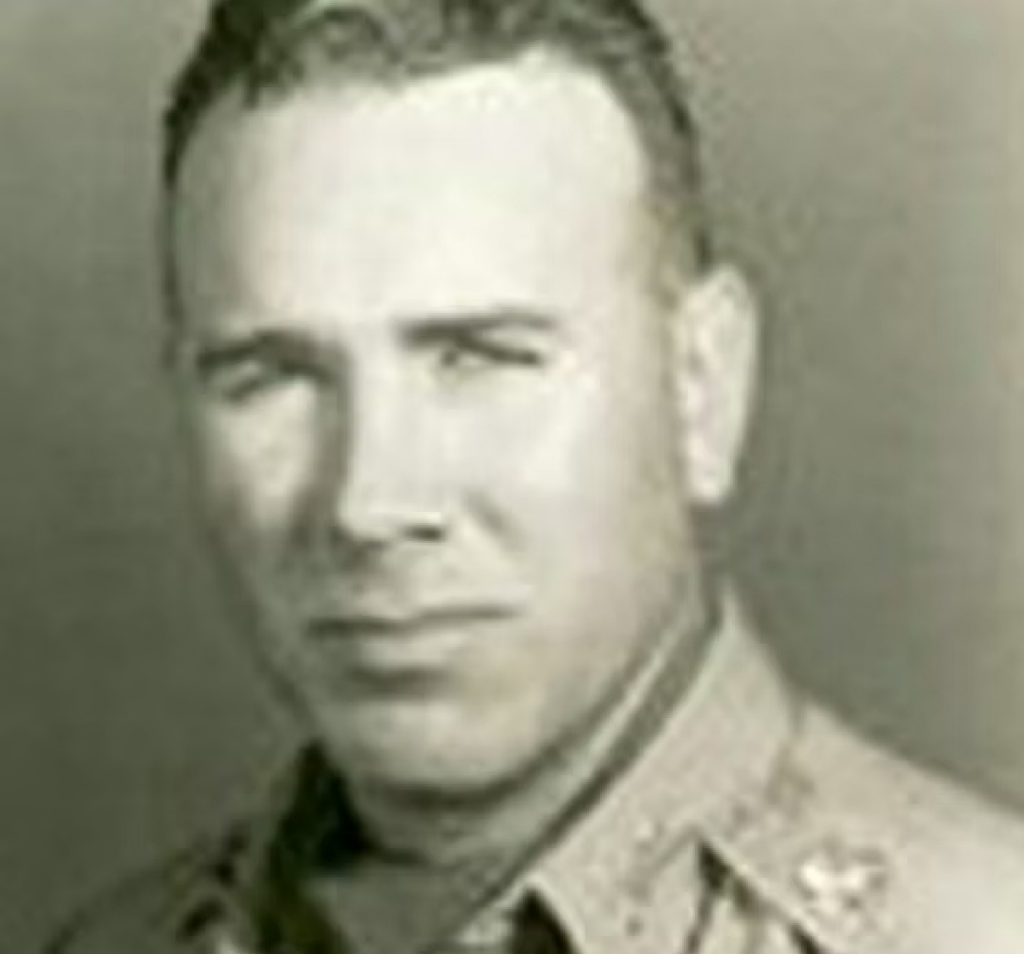
Captain GRAYSTON LYNCH, US ARMY (retired), Central Intelligence Agency
Grayston Lynch
(June 14, 1923 – August 10, 2008)
Grayston was one of the CIA/SAD Paramilitary Operations Officers who commanded the Cuban rebel army during the Bay of Pigs Invasion. He was the first to land on the beach and fired the initial shots of the battle. He is revered among Cuban Americans for his heroics during the failed invasion, which included several voluntary rescue missions to save stranded members of Brigade 2506.
The other CIA Paramilitary Officer was William “Rip” Robertson. Lynch had an extraordinary history of valor in service to his country.
He was wounded at Normandy, fought in the Battle of the Bulge, and Heartbreak Ridge in Korea; served with the Special Forces in Laos; and received three Purple Hearts, two Silver Stars and one Bronze Star with a “V” for valor.
He was selected from the elite to become a Paramilitary Operations Officer in the CIA’s famed Special Activities Division in 1960. For his extraordinary heroism during the Bay of Pigs Invasion, Lynch was awarded the Intelligence Star, the “CIA’s most coveted award”. [17] In the six years after the Bay of Pigs Invasion, he ran commando raids into Cuba. Lynch retired from the CIA in 1971.
He wrote a book, “Decision for Disaster: Betrayal at the Bay of Pigs”, based on his experience leading Brigade 2506.
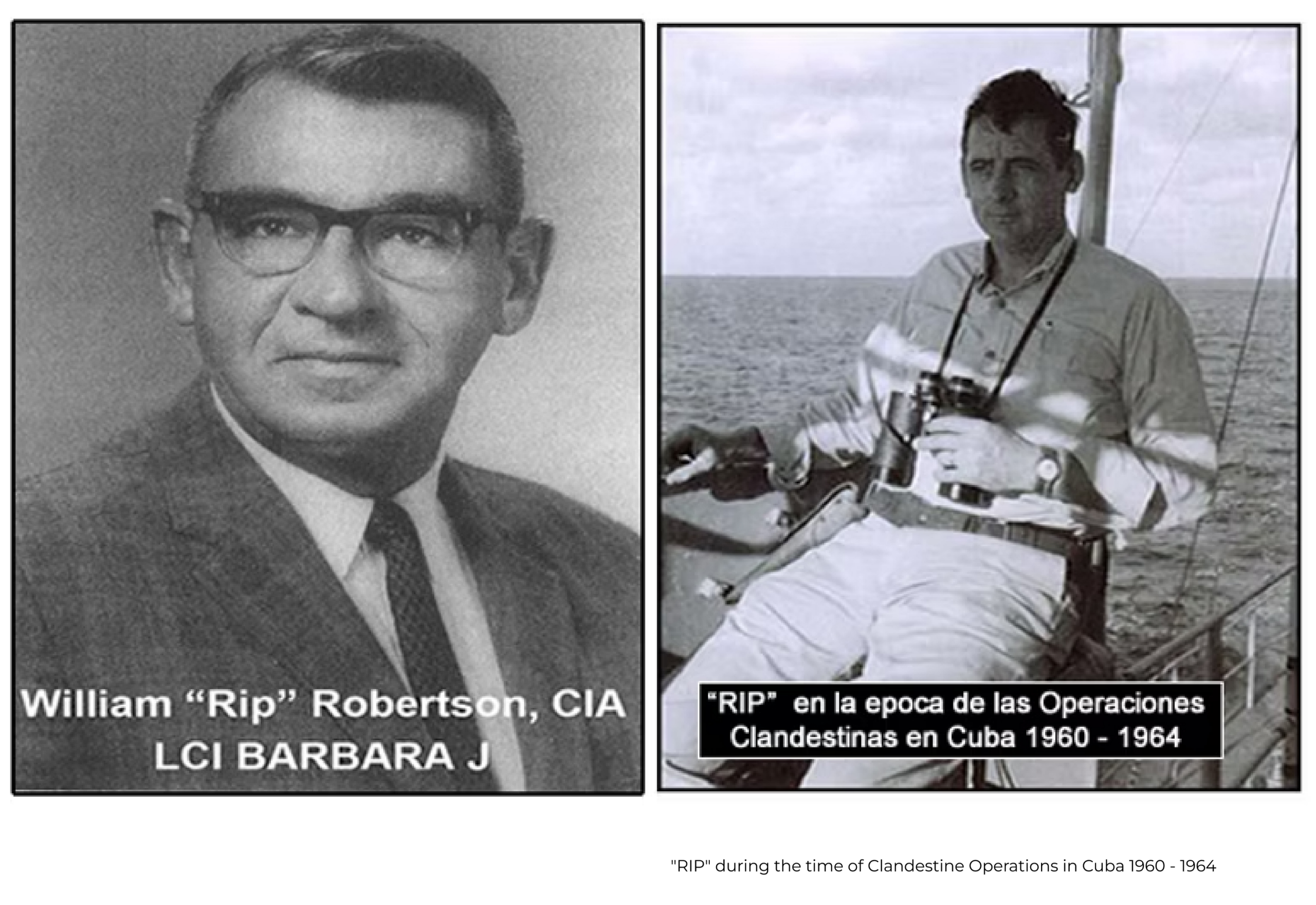
WILLIAM “RIP” ROBERTSON, Central Intelligence Agency
William “Rip” Robertson was an American Central Intelligence Agency (CIA) operative. Robertson was born in Texas and attended Vanderbilt University before and after the war. During World War II he enlisted in the United States Marine Corps and served in the Pacific Theater as a Captain and served during the Korean War. He later entered the CIA in 1947 and served as a Paramilitary Operations Officer in their famed Special Activities Division.
He was assigned to the Executive Action operation that was designed to remove unsatisfactory (to the CIA) foreign leaders from power. One such action was the overthrow of the president of Guatemala Jacobo Arbenz in 1954. Later Robertson was discovered to be responsible for ordering a British ship bombed, he had misidentified it as a Russian ship. Afterwards he was deemed an outcast by the CIA. He then worked as an advisor to Nicaraguan President Anastasio Somoza Garcia.
Prior to the Bay of Pigs invasion he resumed work for the CIA. During the battle he commanded the ship LCI Barbara J, and disembark in Red Beach with the UDT team, while Grayston Lynch commanded the ship LCI Blagar. After Bay of Pigs treason, he continues working with the cuban commandos raid into Cuba. When the President Lyndon Johnson cancelled all of the operation against Cuba, he continued working in clandestine operation and was the lead of a unit of Cuban exiles commando, former veterans of Bay of Pigs. The Cuban commando rescue in Kisangani, Congo a group of missionaries in November 24, 1964, and led by CIA’s Rip Robertson, that operation was named Operation Makasi. Rip also was in Vietnam, training the guerrilla.
(visit “FREEDOM FIGHTER” page and read the history from the Missionaries rescued, also visit the folder “Documentos TOP SECRET” go to the Blue Folder, and you will read unclassified documents from Grayston L. Lynch and William “Rip” Robertson, report for the Investigative Committee chaired by Gral. Maxwell Taylor on May 4, 1961)
Commander HAROLD ” HAL” FEENEY, US NAVY
Robert “Bob” C. Stevens, official in charge of clandestine maritime operations and Chief of the Pine Key Base, where he supervised the vessels PT Susan Ann, ASR El Barbero, and the prowler WASP.HAROLD “HAL” FEENEY, aka EL QUIJOTE, Commander, US Navy
9/22/1922 – 6/9/2012
Hal attended Valley Forge Military College 1941–1942. Later while attending the University of Southern California, World War II broke out and word came that his brother Wakefield had been killed at sea. Hal immediately quit the University and volunteered to serve in the Army, attended the War Department Military Intelligence Training Center and later the Infantry Officer’s Candidate School. He was sent to the Command and General Staff School to help teach the course in Chinese to Army Officers from China.
After World War II, Hal finished his studies, taught Spanish and French at the University of Southern CA, University of PA and the Valley Forge Military College in PA. Hal accepted from the US Department of State the position of Director of the US Ecuadorean Cultural Center in Quito (1949–1950). Meanwhile, he had switched his commission to be a US Navy Intelligence Reserve Officer to honor his brother. After the Korean War broke out, Hal was called to duty in 1950 in Naval Intelligence. He served as Special Agent in Panama (1952–1954). He was appointed from Reserve to Regular Navy (1943) and made it his career. He also served as Naval Attache at the US Embassy in Paris, France (1957–1959) and later as Chief of Intelligence Plans Unit at NATO Headquarters in France and in Belgium when NATO relocated there (1966–1968). Hal served as Chief of Intelligence at the US Guantanamo Base in Cuba (1960–1961) and helped to infiltrate and operate CIA trained exile Secret Agents into Communist Cuba, at times accompanying them on missions.
Hal was awarded the Medal of Valor by Brigade 2506 for his actions in the effort to free Cuba.
During the Missile Crisis in 1962, Hal was appointed Chief of the Cuba Branch of the Defense Intelligence Agency. Hal served as an advisor at meetings of the Executive Committee of the National Security Council chaired by President Kennedy at the White House.
Hal was twice awarded the Joint Service Commendation Medal and numerous classified commendations for specific actions in the Intelligence Service. Foreign awards include the Spanish Navy Meritorious Cross and the International Eloy Alfaro Cross.
In 1970 Hal gave up a promotion to Captain in order to start a new career as a Vice President of Great Western Corporation, with headquarters in Corpus Christi, Texas. After a few years Hal quit the business world and became a Special Investigator under contract with several entities of the Federal Government. With his many years of experience in counter-intelligence to serve his country during disturbing times. His knowledge of seven languages was called upon frequently in his career.
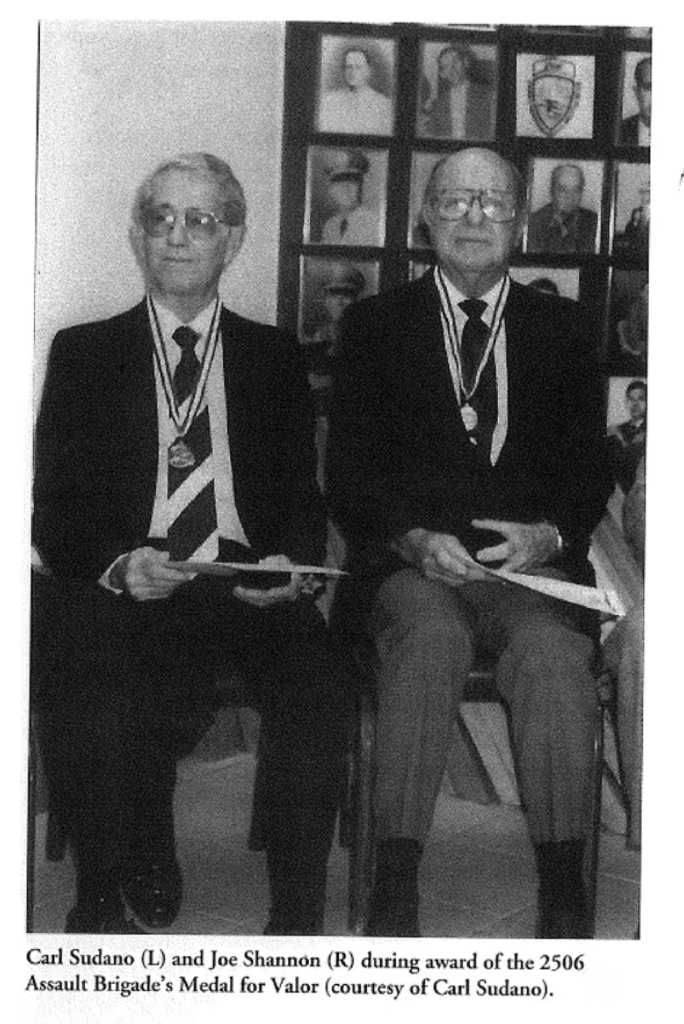
Carl Sudano and Joe Shannon during award of the Brigada de Asalto 2506, Medal for Valor.
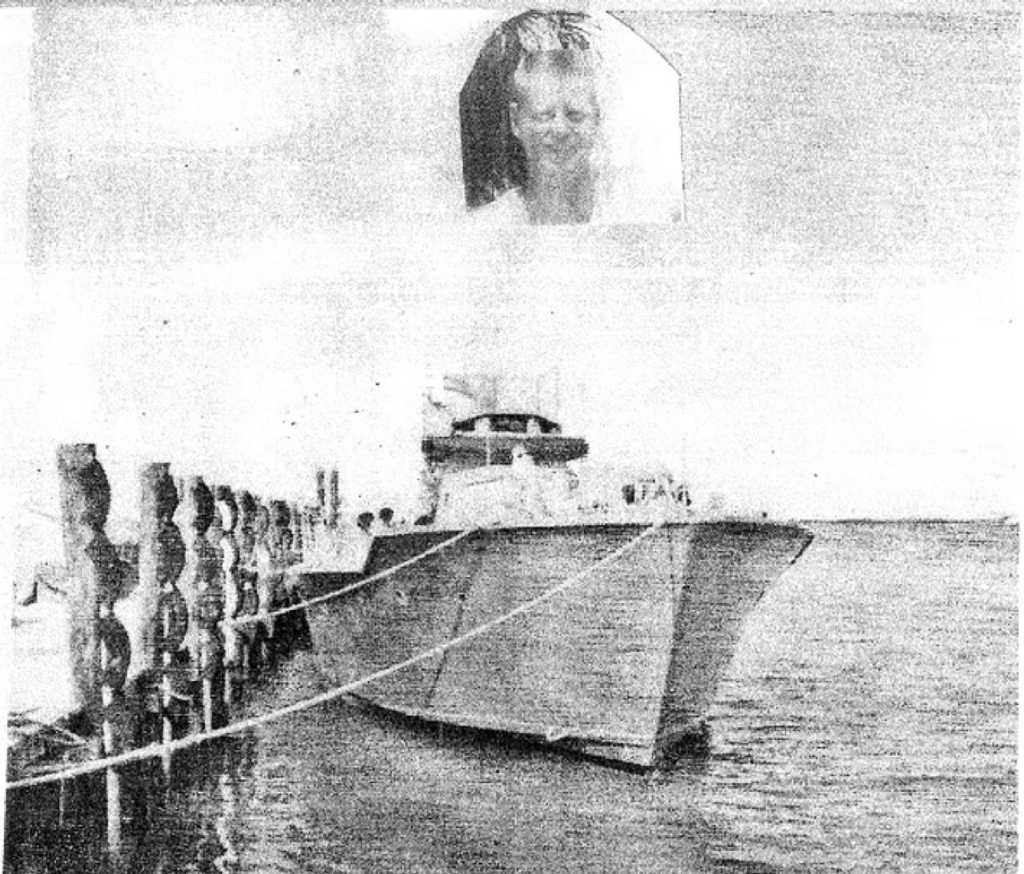
Robert “Bob” C. Stevens, official in charge of clandestine maritime operations and Chief of the Pine Key Base, where he supervised the vessels PT Susan Ann, ASR El Barbero, and the prowler WASP.
Farewell to our Commander
Robert C. Stevens
Born June 29, 1929 – Died October 8, 2010
Bob, as we called him, was a natural leader. He was a graduate of Kings Point, Class of 1953, a U.S. Naval Reserve officer (former Underwater Demolition Team member), a helicopter pilot (1954–1958), and a CIA case officer (1960–1965).
In his association with the Cubans, he earned the loyalty and respect of his subordinates, proving that he was always willing to share whatever risks the operations required. At times, this meant bending the rules—such as joining the crew on a round trip to Cuba.
He was the first skipper of the sub-chaser El Tejana in 1960, the vessel that was brought from Texas to Florida. He trained us in small-boat handling using the Black Cat for UDT personnel and reconnaissance teams, as well as for the infiltration of insurgent teams (1961).
As Chief of the Big Pine Key Base, he supervised the crews of the PT Susan Ann, the ASR El Barbero, and the prowler boat Wasp (1961–1962). Later, he organized a fishing fleet of Cuban boats to recruit personnel and establish infiltration routes, including the Sigma, the Hilda Maria, and the Angelina (1962–1965).
Through him, we obtained the help and guidance of key individuals such as César Diosdado, Deputy Chief of U.S. Customs in the Florida Keys, and the owners of the 8th Avenue boat slip, Mrs. Katherine Parks, who was always ready to assist us.
He left the company in 1966 and, in 1970, founded the Continental Shelf Association, an environmental consulting firm specializing in applied marine science and technology within the maritime industry. He was the first to introduce underwater cleaning methods later recognized by all classes of maritime surveyors.
He never surrendered his principles and was proud of his association with us, assisting at every April 17 anniversary—the date of the Brigade’s landing—and at the annual luncheon of the Cuban Special Operations Association.
As I later realized while attending the Officer Candidate School in Newport, Rhode Island, during the course on Naval Leadership, Bob had already taught us—through his example—nearly every chapter of that subject.
Dear Bob, you now belong to a legion of honorable Americans who served their country without asking for honors or privileges in return.
Your faithful Cuban friends

The Bay of Pigs Museum and Library is a non-profit organization and operates with the support of the Miami-Dade County Department of Cultural Affairs and the Cultural Affairs Council, the Miami-Dade County Mayor and Board of County Commissioners. It is also sponsored in part by the State of Florida, Department of State, Division of Arts and Culture, the Florida Council on Arts and Culture, and the National Endowment for the Arts.